HomeAdviceFunding sources available to new businesses
Funding sources available to new businesses
Introduction
Wanting to start or grow your business? What funding options do you have available?
Options are not limited to banks and private investors. There are many sources of funding available. It is a case of knowing what is out there and is suitable to you. This article discusses some of the main funding sources. Each is described briefly, with a link to further details.
Angel investment
Angel investors are individuals who have capital they wish to invest in new businesses. This is in exchange for an equity share in the business.
Angel investors require robust business plans, with cost details, return on investment and marketing plans. Have a pitch ready to win them over. It will take time and effort to raise capital this way.
For further information visit the UK site angelinvestmentnetwork.co.uk.
Asset finance
New businesses will need upfront investment, such as business equipment and vehicles. This requires capital that you may not have. Asset finance is a way to pay for business-critical assets in instalments, via a leasing or renting arrangement.
For further information visit the Entrepreneur Handbook page.
Bonds and guarantees
Bonds and guarantees provides a purchaser with the security that they will receive financial compensation from the bank if the services or goods are not delivered as per the contract.
For further information visit the Trade Finance Global page.
Business cash advance
This is an advance lump sum for the business to get started and can be paid off as a percentage of your monthly business card takings, instead of a fixed monthly payment. So, the payments are tailored to your cashflow.
Business credit card
This option allows the business to pay off the debt via a business credit card. Shopping around for a good deal is essential here to avoid large interest payments, unless you pay off your monthly credit spend in full.
For further information visit the business credit card comparison page.
Business overdraft
Depending on the term of your spending, an overdraft may be a suitable option. This is a borrowing facility linked to your business account, which is paid off at the agreed interest rate. It is usually suitable for short-term expenditure.
For further information, visit the Pros and Cons of overdraft page.
Community Development
This is government funding for projects involving the development of communal facilities for example. This is available in England and Wales only.
Visit the government Community projects page for more details.
Finance Institution
These are companies which deal with financial transactions such as deposits, loans, investments, and currency exchange. Examples are investment banks, commercial banks and insurance companies.
Continuous improvement
Do not rely purely on a formal evaluation schedule to gather feedback. Obtain ongoing input from employees performing the activities, being impacted by the activities, suppliers and customers, as appropriate. Once you get feedback that indicates a refinement is needed sooner than planned, do not wait. Start the review promptly, but always in a structured way. Keep learning and consider new ways of doing things. However, remember to remain grounded and evaluate any changes you are considering on the overall process and any dependent processes.
Development finance
Organisations owned by the government or charitable institutions, which provide risk capital for economic development projects on a non-commercial basis. They provide funds for projects that would otherwise not be able to get funds from commercial lenders.
Enterprise Finance Guarantee
This is a loan guarantee scheme, which provides the lenders with a government-backed guarantee for 75% of value of each individual loan. This helps facilitate a loan where one may not have been offered. The guarantee provides protection to the lender in case the borrower defaults.
Visit the government Enterprise Finance Guarantee page for detail.
Equity
Equity financing is the process of raising capital through the sale of shares. Equity investors are prepared to put up risk capital in return for a share in a growth business. Formal equity finance is available through several different sources, such as business angels, venture capitalists or the stock markets.
Visit the government Equity finance page for detail.
Export finance
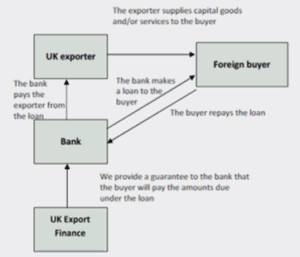
The UK government supports exports for any company size and across all sectors from capital goods to services and intangibles such as intellectual property.
Visit the government Export finance page for detail.
Government-backed schemes
You can apply for a government-backed start-up loan to start or grow your business. This is an unsecured personal loan.
Visit the Government loan page for more details.
Grant
These are funds that do not need to be paid back. They allow voluntary and community organisations to provide services or activities.
There are over 4,000 grant funders in the UK, and the process is highly competitive.
For further details visit the Grants page.
Invoice finance
Invoice finance allows businesses to apply for finance using invoices for money owed to them as security. So, businesses can sell their invoices to a third party for a percentage of their value. This helps businesses whose growth is hampered by slow payment of invoices.
For further details visit the Invoice finance page.
Letters of credit
These are letters from a bank, which guarantees that a buyer’s payment to a seller will be received on time and for the correct amount. The bank will make the payment in case the buyer is unable to. Visit the government Letters of credit page for detail.
Loan
Loans from different companies are available for businesses. It is a good idea to compare loan repayment terms and interest rates, to make sure you have the most suitable type for your business needs. A comparison site could be the best place to start your research.
Mezzanine finance
This is a combination of debt and equity financing. The borrowing company generally has longer to pay back the loan, with a higher interest than other loans.
In case of non-payment, the lender can convert its debt into equity in the borrower’s company. Visit the Mezzanine finance web page for further details.
Peer to peer lending
This provides opportunities for individuals to lend directly to other people or businesses without using a bank. Lenders place their money with a peer to peer platform, which is then lent to different borrowers as small loans. The platform collects the repayments of interest and capital from each borrower for the lenders. For further details visit the Peer to peer lending page.
Start-up finance
This is a government-backed scheme to help individuals start or grow a business in the UK. There are low-interest loans with access to free mentoring from experienced advisers.
Supplier finance
This allows for goods or services to be delivered to a buyer using deferred payment terms. This is used when exporting goods to buyers based in countries outside UK. For further details visit the Supplier finance page.
Syndicated loan
This is a credit facility provided by multiple lenders under a single loan agreement. So, the bank sells a portion of its lending commitment to a syndicate of lenders. Thereby, reducing its own credit exposure. Visit the Market Business page for more information .